Showing posts with label president. Show all posts

Tuesday, December 1, 2009

Carlos Polístico García


Carlos P. Garcia was born on November 4, 1896 and became president of the Philippines on March 23, 1957 after President Ramon Magsaysay died in a plane crash. He was elected December 30th that same year to a full term as the 8th president of the Philippines. Before he took office as president he was a teacher, lawyer and public official. Garcia become well known for his “Filipino First” policy in which he placed the well-being and interests of the Filipino people above any foreigners and those belonging to the majority ruling party.

Garcia was born in Talibon, Bohol. He went to Cebu Provincial High School and Silliman University then got his law degree at the Philippine Law School. Instead of practicing law immediately, Garcia worked as a teacher at Bohol Provincial High School. Garcia was also notable for his poetry in Bohol that people referred to him as the “Prince of Visayan Poets” and the “Bard from Bohol.”

Carlos P. Garcia began his political career as elected as a representative to the Philippine congress in 1925. Thereafter, he was elected governor of Bohol in 1931 and was re-elected in 1940. He became senator in 1941. Garcia was elected for senate for three consecutive terms between 1941-1953.


Garcia was appointed vice-president as his running mate; Ramon Magsaysay won the election for presidency in 1953. The President then appointed him Secretary of Foreign Affairs for four years while serving his term as vice president at the same time. Garcia assumed presidency following President Magsaysay’s death. After he completed Magsaysay’s term he was elected as the 8th president of the Philippines.

President Carlos P. Garcia is most notably remembered for his “Filipino First Policy” which is a policy that favored Filipino businessmen and citizens over foreign investors and competition. This meant that foreign investors could invest up to 40% in an industry or business while the remaining 60% would be owned by Filipino citizens. Garcia’s policies aimed at stimulating economic growth and prosperity, ultimately obtaining and sustaining economic independence. This included managing retail trade, which affected relations with Chinese business. Among other things, Garcia also tried revitalizing Filipino cultural traditions. He also tried instilling the Austerity Program, which although not as successful as his other policies, attempted to fix the corruption in the government. This helped restore trust between the Filipino people and the government.

Towards the end of his second term, Garcia ran for re-election but was defeated by Macapagal. He retired to life as a private citizen in Bohol and was elected to be a delegate of the Constitutional convention. Shortly thereafter though, Garcia suffered a fatal heart attack and passed away on June 14, 1971.

-V. Armas

Ramon Magsaysay

On November 10, 1953, Ramon Magsaysay was elected as the third President of the Third Republic of the Philippines. The Candidate from the Nacionalista Party had beat out the incumbent Elpidio Quirino from the Liberal Party with a decisive victory of winning almost 69 percent of the vote of the Filipino people. He prove to be the “man of the people” as during his term he made assure that Communism will not take over and that the common man had a voice in Philippine politics. Unfortunately on March 17, 1957 he died in a plane crash after speaking in the provinces of Cebu.

On April 23, 1946, he was elected as Congressman of Zamables because of concerns that his predecessor is forming ties with the Hukbalahap, a militia group form under the Communist Party of the Philippines. The first President of the Third Republic, Manuel Roxas, chose Magsaysay to Washington D.C. to pass the Rogers Bill which would give benefits to Philippine Veterans. This led to a successful mission and he even formed friendships within the United States making him more popular. Appointed by the second President, Quirino named Magsaysay as the new Secretary of National Defense on August 31, 1950. As Secretary, his main concern was to reform his guerilla army to suppress the rebellion of Huks. His main plan was to convince the rebel Huks and common people that reform was coming. As many changed sides, the Huk leaders surrendered. This also maid Magsaysay popular as the common people hoped for him to run in the next election. As a result of his popularity, Ramon Magsaysay became the President from the elections of 1953.


During his presidency, Magsaysay focused on the common people and the suppression of Communist Party. Soon after, he started reconstructing rural areas as roads were rebuilt. With the support of the United States, loans were made to rural banks to help tenants reduce their debt under moneylenders who charged with ridiculous interest. In 1955, his administration passed the Agricultural Tenancy Act, which established a democratic agricultural economy to regulate the size of estates so that it can be sold in the form of smallholdings to tenants. This helped by restricting illegal evictions. Magagsay’s reign of two years dealt with reform to bring a major change of the living standards in the Philippines so that both the rich and the common people will soon have equal power.


In his honor, a Ramon Magsaysay Award is given to individuals of Asia who have portrayed their works of humanity by performing courageous service in the in their society by promoting the ideals behind democracy. The Award is given in six categories: government service, public service, community leadership, journalism, literature and creative communication arts, peace and international understanding, and emergent leadership.

-R. Andal

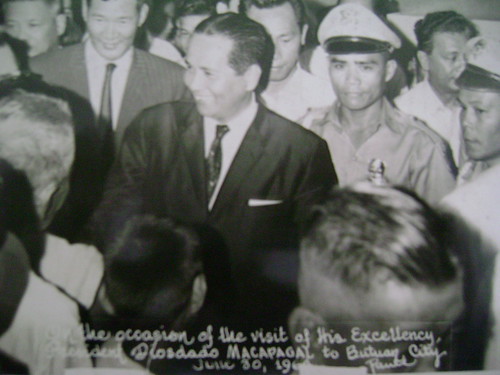
Administration of Diosdado Macapagal


The election of 1961 showcased Carlos Garcia representing the Nationalist party and Diosdado Macapagal representing the Liberal party. Carlos Garcia was the incumbent president seeking re-election. Unfortunately, Diosdado Macapagal, using his background as his campaign was able to topple the current regime. Diosdado Macapagal was able to win the election 55% to 45% with a promise to end corruption while appealing to the people with his background as a common man. With this victory, Diosdado Macapagal became the 9th president of the Republic of the Philippines. After securing his victory, in his inaugural address, he proclaimed, “I shall be president not only of the rich but more so of the poor. We must help bridge the wide gap between the poor man and the man of wealth, not by pulling down the rich to his level as Communism desires, but by raising the poor towards the more abundant life."

With this statement, Macapagal laid the foundation for what would be his agenda as the president of the Philippines. In effort to affirm his statement, Macapagal vowed open the Malacañang Palace to the people. In addition, he tried to bridge the gap between the rich and poor by first starting with the government. Macapagal began to purge the government of corrupt officials who suddenly became wealthy without any explanation. In an effort to raise the morale of his people, he changed the official date of independence from July 4th, 1946 (the day the Americans recognized the Philippines as a sovereign nation) to June 12th, 1898 (the day Filipinos declared their independence from Spain).

A significant part of Macapagal’s term as President was his ability to stimulate economic growth. During the Elpidio Quirino administration, the Philippines adopted a policy which devalued the Peso according to the American dollar. President Macapagal was able to lift this policy which allowed for the Peso to be traded on the open market. This policy plus numerous other policies allowed the Filipino economy to grow by an average of 5.15% GDP. This economic growth was seen all throughout the Philippines as his promise to the poor was partially fulfilled. The growth seen by the Philippines slowly trickle down to the poor.


Unfortunately, President Macapagal was unable to bring about substantial change to the Philippines because of the attempts of the opposition party to block his reform efforts. At the end of 1965, Macapagal sought re-election in order to continue his reforms. Despite his efforts to appeal to the masses Macapagal lost by a substantial number of votes to Ferdinand Marcos. At the end of his political career, Macapagal was elected to be the president of the constitutional convention which drafted the constitution of the Philippines. On April 21, 1997, Diosdado Macapagal died of heart of failure in Manila.

-H.Du

Monday, November 30, 2009

2nd President Elpidio Quirino


Following the unexpected death of President Manuel Roxas on April 15, 1948, Elpidio Quirino took over as the president of the Republic of the Philippines. President Quirino was the second president under the newly independent Republic of the Philippines. Before he became the second president, Elpidio Quirino was the vice-president under his predecessor. As his first official act, President Quirino proclaimed a state of mourning for their formerly deceased President, Manuel Roxas. Following the state of mourning, President Quirino launched his agenda of economic reconstruction and the restoration of faith into the government.

In order for President Quirino to bring about economic reconstruction to the Philippines, he created the President’s Action Committee on Social Amelioration (PACSA). PACSA’s responsibility was to help resolve the problems of poor families. He also had the Labor Management Advisory Board help by providing assistance on the human capital in the nation of the Philippines. In addition, President Quirino provided aid to the farmers through the education of farmers to market their crops as well as preventing them from relying on loan sharks. Everything President Quirino did in terms of economics was to try to build a stronger and more reliable economic infrastructure. Realizing what needed to be done, President Quirino focused more on the rural areas because that is the basis of any economy.


After helping to obtain independence for the Philippines, President Quirino knew that he had to bring about support for the government. There is no way a government can function, even if it is sovereign, without the support of the general population. Following the example set by U.S President Franklin Delano Roosevelt, President Quirino held fireside chats to try to boost morale in his nation. He held the fireside chats Malacañang Palace, which is the official residency of the president. In these chats, he would provide the people of the Philippines with the activities of the government and what they were planning to do. These chats were a way for the president to communicate to the people directly and keep them involved in the government.


Despite his efforts, President Quirino faced social unrest, especially coming from the Hukbalahap movement. In an effort to quell the Communist movement, President Quirino negotiated with the Huk commander Luis Taruc. However, the negotiations failed as the commander called for an overthrow of the government. President Quirino, during his reign as the President of the Philippines was able to create economic growth, but was unable to resolve the social problems that plagued the Philippines. As Elpidio Quirino ran for re-election in 1953, he faced staunch opposition from the Nationalist Party. With a combination of Elpidio Quirino’s failing health and social unrest; he was defeated by Ramon Magsaysay. After this failed re-election attempt, Quirino retired to Quezon City and died of a heart attack on February 29, 1956.

-H.Du

Saturday, November 28, 2009

Manuel Acuna Roxas


*Image taken from: http://www.philippine-history.org/presidents.htm

Manuel A. Roxas served as the third and final President of the Commonwealth of the Philippines from May 28, 1946 to July 4, 1946. On July 4, 1946, the scheduled date for the American recognition of the independence of the Philippines, Roxas became the first president of the Third Republic of the Philippines. He served for barely two years until a heart attack on April 15, 1948.

Manuel A. Roxas was born on January 1, 1892 in Capiz City (later renamed Roxas City). He received a law degree from the University of the Philippines in 1913.

Roxas’s early political career began in 1917, where he became a member of the municipal city council of Capiz. He became their governor two years later. Three years later he was elected to the Philippine House of Representatives as Speaker of the House. In 1941 he was elected to the Senate, but due to Japanese occupation, did not begin his term for another four years.


*Image taken from http://forum.philboxing.com/

During World War II, Roxas served in the Filipino military as a reserves officer. In 1942 he was captured by Japanese forces and imprisoned. There he became commanding officer of the camp’s prisoners of war. He initiated programs for the prisoners and his leadership impressed his captors. This is when they became interested in Roxas heading a Japanese-sponsored puppet government in an attempt to gain Filipino support for the occupation.

There is speculation as to Roxas’s allegiance. He never served in outright support of the occupation, however did participate underneath the puppet government, leading some to later criticize him as a traitor. He helped with drafting a Constitution in hopes to include Philippine democracy in the document. He also headed Bigasang Bayan (BIBA), responsible for controlling rice prices and distributing rice amongst civilians and Japanese soldiers. While Roxas saw the position as an opportunity to help his countrymen, some saw his involvement as aiding the enemy.

Roxas was freed by General MacArthur and his troops. While he was arrested and tried for cooperating with Japanese troops, he was later pardoned. His political career was reinstated and he beat Sergio Osmena in 1946.

During his term under the Commonwealth, Roxas was preparing the country for independence as well as recovery from the war by passing two important laws: the Philippine Rehabilitation Act and the Philippine Trade Act AKA the Bell Act. Both laws were accepted by Congress and drastically changed the economic and political landscape of the Philippines, as well as the relationship between the two countries.

Other important laws and acts passed under Roxas and his cabinet:
-the Parity Amendment in the Constitution
-the 1947 Military Bases Agreement
-declared amnesty for Japanese allies during World War II (unless they committed violent acts)

-c. simpliciano