Showing posts with label government n policy. Show all posts

Tuesday, December 1, 2009

The Manila Pact aka SEATO

The Southeast Asia Treaty Organization (SEATO) was an international organization and alliance for collective defense against growing communist influences mainly in Southeast Asia, the Philippines included. The treaty was signed by the United States, the United Kingdom, France, Australia, New Zealand, Thailand, the Philippines and Pakistan in Manila, Philippines on September 8, 1954. The treaty became effective in February 1955 and bound the countries to mutual aid to resist any armed attacks. It was assumed that one attack on any one of these countries meant that it was an attack on all the countries so therefore the countries did their best to aid their fellow treaty signature countries.

Historically, SEATO was supposed to mimic NATO and be the Southeast Asian version of the North Atlantic Treaty Organization (NATO). Its purpose was to ideally have military forces back up each member if the call for defense was needed.

Members of SEATO reflected strong forces within each of their region. The U.S. and the United Kingdom obviously were the western powerhouses. Other countries such as Australia, Thailand, New Zealand and the Philippines signified “westernized” nations in the Southeast Asian region.

Originally, Pakistan was not included but treaty forces felt that they needed East Pakistan (now Bangladesh) to be a part of their organization because the country itself is so geographically near to Southeast Asia. They believed that this would tie together Mid-East and Southeast Asian countries.


In comparison to the NATO alliance, SEATO did not hold joint commands with other forces. Also, the attack on one treaty member did not automatically mean there was an attack on all members even if that was the ideal purpose. This was a weakness for the alliance, which caused discrepancy in support for each other. Following the disinterest of France following communist conflict in Cambodia, the United Kingdom also began to lose faith in SEATO causing SEATO to be unreliable as a secure organization. This caused the Philippines to not rely on SEATO as a form of protection against communist insurgencies within their own country.

Due to the lack of reliability and security among the members, and ultimate membership withdrawals, SEATO was disbanded on June 30, 1977.

-V. Armas

War Brides, "1946 Boys", and Military Recruits


The United States of America is known as the land of promise, which would explain the waves of immigration that they received from all countries. The Philippines had several waves that ended with several enacted laws by the United States government.

As defined by some scholars, there are four major waves of Filipino Migration. The first of these waves was during Spanish rule; some Filipinos wanted to get away from the Catholic rulers and found their way into a new country in North America, whether it was Mexico or the U.S. This ended with the uprising wars between the Spanish and Filipinos around 1906. The second wave was during the 1920s when the U.S. considered the Filipinos as U.S. Nationals and needed them for cheap labor. However due to violence and opposition towards these workers, the Tydings-McDuffie Act was passed in 1934 which reclassified Filipinos as aliens and maintained an immigration quota of 50 persons per year.

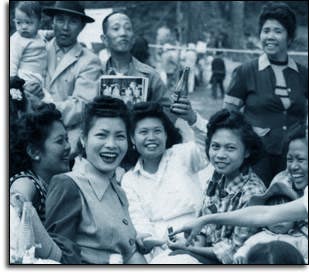
The third wave of immigration occurred in 1946 after WWII and during the granting of Philippines independence. The majority of these immigrants were war brides, the “1946 boys”, and military recruits who were now given the opportunity to become U.S. citizens. Contributing to this third wave of immigration were the War Brides Act of 1945, Luce-Celler Act of 1946, and the Military Base Agreement of 1947.

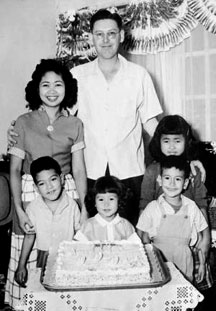
The War Brides Act of 1945 (amended by the Soldiers Brides Act of 1946 and 1947) stated that the ethnic spouses of American GIs, also known as war brides, and their children were allowed to enter the United States after World War II. This allowed Filipino wives and their children to come to the U.S. alongside their White American husbands and fathers. This act lifted the Immigration Act of 1924, which only allowed 2% of the number of immigrants already living the U.S. in 1890 to enter America that was made purposely to exclude Asian and Eastern European immigration. After the passage of the War Brides Act, it was estimated that 5,000 brides came into the U.S. not including their children. This is significant because it wasn’t until the 1967 when interracial marriages were nationally legalized and accepted.

On July 2, 1946, President Harry Truman signed the Luce-Celler Act of 1946 which opened immigration for Filipinos and Indians into America with the quota of 100 persons per year and granted them naturalization. This is double the immigration quota that the Tydings-McDuffie Act allowed before 1946. This gave more opportunities for labor of Filipinos in the U.S. Contracted workers called the “1946 boys” also contributed to this wave of immigration. There was said to about 7,000 of these boys who were part of the agricultural laborers that entered into the Hawaiian sugar plantations. These men were significant because they were brought into the sugar plantations by the owners in an attempt to end the interracial strike by the International Longshoremen and Warehousemen's Union (ILWU). This strike ended in victory for the workers and benefits for the Filipino workers.

Lastly, the Military Base Agreement of 1947 and the end of racial segregation in the military allowed for Filipino military recruits to enter the United States and work in the mess halls. This gave way for another 20,000 Filipinos that immigrated during the late 1940s and early 1950s.

The third wave of immigration is significant because it brought about many changes. Filipino women can enter the U.S. through their American husbands, Americans were seeing interracial couples, and Filipino men had jobs once again. This was a significant change from the previous Tydings-McDuffie Act and Immigration Act of 1924. To some historians, this wave of immigration ended in 1965; however, it didn’t end rather it expanded dramatically with the Immigration and Nationality Act of 1965 which contributes to the current immigration of Filipinos today which doesn’t have any quota.

-V Chavez

Monday, November 30, 2009

U.S Grants Philippines "Independence"

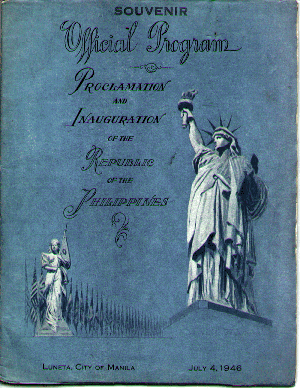
On July 3rd, 1946, the United States granted independence to the United States. President Harry Truman signed the Treaty of General Relations, also known as the Treaty of Manila, which recognized the Republic of the Philippines as its own sovereign nation.


The picture depicted above shows President Truman signing treaty on July 3rd. As a display of American symbolism, the treaty came into effect the next day on July 4th, the same day in which the United States announced the Declaration of Independence. In a similar respect, the United States was declaring independence for the Philippines when President Truman signed this treaty.
Unfortunately, many Filipinos recognized this day as the Independence Day that wasn’t. The United States created a veil of kindness when it signed the treaty, but when looking at the fine print of the treaty; it is obvious that the Philippines were not truly free. The price of freedom came with many chains attached to it. Specifically, there are two aspects of the independence that has turned this act of kindness into a display of American might.


Although the Americans granted the Philippines independence, the United States still kept its presence in the Philippines. After this treaty was passed, the United States still claimed dozens of military bases in the Philippines. These bases included major bases, which were the basis of U.S operation in the Asian region. With the United States holding onto their military bases, this was a display which showed that the United States still had control of the Philippines. Even though the Philippines were granted independence on paper, they were still under the watchful eye of the United States military. The Philippines were granted independence in name only, but they were still the little brown brother to the United States.

The second aspect that is important to look at is the Bell Trade Act. The Bell Trade Act is also known as the Philippine Trade Act because it specifically focuses on the Philippines. The Bell Trade Act specified the economic conditions in which the Philippines had to meet if they wanted independence. Specifically, the act created a system of tariffs which was favorable to the United States. It also measured the Peso to the U.S dollar. The Philippines government also could not place restrictions on currency transfers from the Philippines to the United States. And the act gave the United States equal access to the natural resources of the Philippines. The Bell Trade Act effectively traded Filipino independence for the economic growth of the United States. The restrictions placed on the Philippines were indicative that the United States still had a hold of power in the Philippines. The Bell Trade Act made sure that the Philippines would never eclipse the United States as an economic might.


The date July 4th, 1946 might be the day that the United States recognized the Republic of the Philippines as a sovereign nation, but it is a date that most Philippines recognize as a reinforcement of United States’ colonial might. With numerous provisions to their independence; it is difficult to recognize this treaty as a victory for the Filipinos. If the United States truly wanted to grant the Philippines independence; they would not have retained their military bases and limit the economic growth of the Philippines with their restrictions. Unfortunately for the Philippines, the United States were able to flex their proverbial muscles while acting kind at the same time.

-H. Du

Saturday, November 28, 2009

The Huks


*Image borrowed from watawat.net

Hukbo ng Bayan Laban sa mga Hap, the “People’s Army Against the Japanese” was a Communist-led guerrilla group formed during World War II to fight Japanese soldiers. The Huks, as they are most commonly known, consisted of countryside peasants mainly from central Luzon. The group of peasants formed not just a result of the Japanese occupation-- the peasants were descendants from lines of farmers who have had their lands taken from the Spanish. Now that they were suffering the same treatment from the Japanese, they have finally organized into a collective group. Their leaders educated and enlightened their followers and supporters, and the Huks grew to be an educated and aware group.

During the war it is estimated the Huks had 70,000 men and women fighters and supporters. They stole weapons and supplies to fight the Japanese troops, intercepted supplies enroute to the Japanese, and continued to educate their fighters not only on Marxist-based warfare and military tactics, but social issues. Their guerilla tactics proved successful against the Japanese.

After the war the Huks continued to grow in number and power, now recognized as an anti-government rebel group. Their focus remained on land reform, an issue they felt the Filipino government was failing poor Filipinos on, especially after the government had basically signed over plenty of their resources to the United States government. Throughout the Philippines the Huks acted as a Robin Hood group, often killing powerful landlords and dividing large pieces of land amongst the poor.

The Huks began to post members in political positions of power. However they were unseated by members of the Liberal Party. The Huks then began the Huk Rebellion, which lasted from 1946-1954, an attempt at overturning the Filipino government. As President Manuel Roxas took office and signed over many Filipino freedoms and power to the US government, political unrest stirred more Filipinos towards the Huks. They especially targeted his leadership, as his prior involvement with the Japanese puppet government painted him a possible traitor to the Filipinos. They changed their name in 1948 to Hukbong Mapagpalaya ng Bayan (Liberation Army Movement) shifting their focus from the Japanese.

As the popularity of the Filipino government began to falter, the Huks continued to gain supporters, and they began making their way to Manila. However, their headquarters were raided and their most important leaders were taken in that single raid. At this time, the Second Red Scare (a period of strong anti-communism) had taken over the world, and President S. Truman sent over large amounts of weapons in order for the Filipino government to fight the Huks.


*Image borrowed from asiaobserver.com

The election of Ramon Magsaysay in 1953 brought back the trust of the Filipino people. The power of the Huks further faltered, and a year later Huk leader Luis Taruc surrendered. The end of the Rebellion had come, and soon afterwards remaining Huks had been reduced to bandits.

Today some Huk followers have joined other anti-government groups, others still remain in hopes to push for land reform. All in all, the Huks no longer pose as a threat to the Filipino government.

-c simpliciano